In the mid-1960s in East L.A., the Sisters were the Eastside's
answer to Motown's Supremes. Like the Supremes, they
were three well-dressed, classy, female vocalists who could
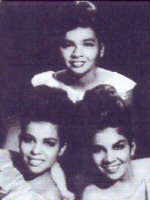
sing extremely well. The Sisters were actually formed
several months before the Supremes burst on the national scene.
However, according to Ersi and Rosella, although they liked
and were influenced by the Supremes, they were more influenced
by other female vocal groups such as Martha & the Vandelas
and the Ronettes. The Sisters recorded three singles
in 1965 for Bob Keane's DelFi Records and were a fixture on
the East L.A. music circuit of the era. Ersi went on
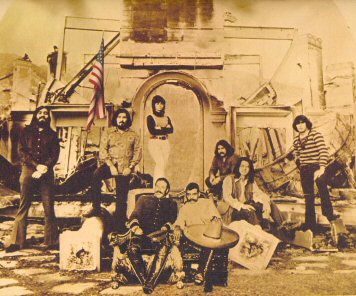
to sing with El Chicano on their second album, "Revolution,"
where she provided the lead vocal to their classic recording
of "Sabor a Mi." Rosella, a great singer herself,
has done very well recording and performing ranchera
music with some of the great mariachi bands in the world.
In 2005, Ersi and Rosella sang on Ry Cooder's Grammy-nominated
album, "Chavez Ravine," along with my dad Lalo Guerrero,
Little Willie G, and others. Ersi, Rosella, and Mary
Arvizu are once again singing together in La Chicana and Her
Revue, where they sing pop and r&b songs from the era
of the Sisters with a rock band, in addition to ranchera music
with mariachi.
Ersi, Rosella, and Mary Arvizu grew up in East Los Angeles.
Their parents were musical performers who went by the name
Dueto Arvizu. They played parties, weddings, and concerts,
including appearances at the legendary Million Dollar Theater
in Los Angeles. Their father, Arturo, was a singer/guitarist
and their mother, Rita, a singer/songwriter/guitarist.
Their father was raised in Tucson's Barrio Libre, where my
father also grew up. My dad knew Arturo Arvizu and family in those years. In fact, Arturo's
sister Aurora was my father's brother Frank's second wife.
In my dad's classic song "Barrio Viejo," my dad
mentions Chalita, Turo y Manuel. Chalita was Rita's
sister (aunt of Ersi, Rosella, and Mary) and Manuel was her
husband. Turo was their dad, Arturo Arvizu. ("Barrio
Viejo" appears on Ry Cooder's 2005 album, "Chavez
Ravine.") When Ersi, Rosella, and Mary were kids,
their parents would take them to their gigs at parties and
weddings where they would sing, at that point exclusively
in Spanish. As they got older they would learn to sing
the pop and r&b songs of the day. Arturo Arvizu
was very strict with his daughters and would not allow them
to go out and sing on their own, even when they were already
teenagers. Rosella had gotten an offer to sing with
a band and play at East L.A.'s Garfield High School Sports
Night, which was a big deal of a gig at that time. (I
remember being very excited, along with my Mark & the
Escorts bandmates, when we got our first Sports Night gig.)
Rosella convinced her dad it would be alright and she
would be chaperoned. He allowed her to do it.
As fate would have it, at that performance she was seen by
manager/producer Billy Cardenas. Billy was very impressed
with her and asked if she had any sisters. It sounds
like the classic pick up line, but Billy had a vision of creating
a Chicana female vocal group in the mold of some of the great
black female vocal groups of the day. She told him she
did have two sisters that sang and the Sisters were born.
Billy got them gigs at the major venues of the Eastside
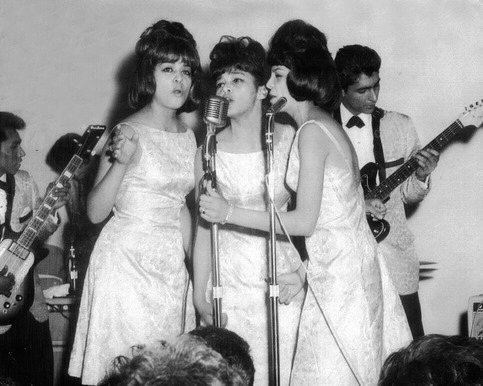
circuit. They were at first backed by the Premiers, who later were
to score a national hit with "Farmer John."
The Sisters performed on the bill with artists such as Tina
Turner, Stevie Wonder, the Righteous Brothers, Sonny &
Cher (when they were known as Caesar & Cleo), and Brenda
Holloway.
When Billy Cardenas thought the Sisters were ready, he took
them to Bob Keane at DelFi Records, where Billy had the Romancers
signed to a deal already. Keane liked what he heard
and the Sisters went on to record three singles for DelFi.
The first single's "A" side was "Gee Baby Gee,"
which was an obscure track that Billy liked on an album by the Dixie Cups. Studio musicians were brought in to back
the Sisters. "Gee Baby Gee" became very popular,
particularly in East of Los Angeles, and remains one of the
classic "Eastside Sound" recordings. Their second
single featured "Ooh Pooh Pah Doo," which enjoyed
similar local success and is also a classic "Eastside Sound"
recording. On the second record they were backed by
another Eastside band managed by Billy Cardenas, Ronnie &
the Casuals. The Sisters and Ronnie & the Casuals
went on to record and perform together on live shows.
In the mid-60s, after a run of only a couple of years,
the Sisters broke up. Rosella stayed with Ronnie &
the Casuals as their lead vocalist. Ersi first sang
in a band with David Torrez, who later was to be a founding
member of Tierra and later pianist and musical director for
Poncho Sanchez. In the late 60s Ersi went on to sing
with the very popular East L.A. band, the Village Callers.
Mary didn't really like show business and wanted to be a nun.
She spent summers at a convent, but her father did not allow
her to became a nun. Rosella eventually married Ronnie
and they had two daughters who grew up to be excellent professional
singers in their own right. (Rosella is presently happily
married to Desi Barraza, a successful retired contractor.)
In 1969, Ersi joined an Eastside band by the name of the VIPs.
This band was to become El Chicano, who went on to have two
national hit records and record six albums for MCA Records
in the 70s. El Chicano's first album was an instrumental
record due to the success of their first hit "Viva Tirado,"
which was a Latin jazz instrumental. Ersi sang on El
Chicano's second album, "Revolution," which I
mentioned earlier featured
her on the classic Mexican standard, "Sabor a Mi."
Ersi's version with El Chicano has also become an "Eastside
Sound" classic. On the same album, Ersi was also featured on "I'm a Good Woman," where she had the
opportunity to show off her blues chops. Rosella eventually
returned to her roots by singing ranchera music, which she
feels is her forte. Rosella has recorded and sung with
mariachi groups, most notably the great Mariachi Sol de Mexico
de Jose Hernandez. In 2002, she released "Sin Tu
Querer." In 2003, came "A los Cuatro Vientos,"
which was arranged and produced by Jose Hernandez Mariachi
Sol de Mexico. Rosella is a world-class ranchera singer
and her CDs bear that out.
My teenage band, Mark & the Escorts, played many shows
on the bill with the Sisters. There are five flyers
on my "60s Eastside Flyers" page on which we share
the bill with them in 1965. The venues include Belvedere
Park Auditorium, the parking lot of Jonson's Market (with
9 other bands!), the Big Union Hall, St. Alphonsus Auditorium,
and the Boulevard Theater. I remember another gig we
did with the Sisters at the Great Western Exhibit Center in
the City of Commerce, where we backed them. However, I don't have the flyer
for that one. I had forgotten until Ernie Hernandez,
the drummer for Mark & the Escorts, recalled backing them because he remembered having
a crush on Ersi at the rehearsal. Ersi confirmed that
we had backed them and remembered rehearsing with
us at our rehearsal space in the basement of our bass player,
Richard Rosas. These remembrances triggered my memory,
however we all seem to have more recollections about the rehearsal
than the show itself. It was all a very long time ago.
In 2004, Ersi was contacted by legendary guitarist/producer
Ry Cooder to be a part of his "Chavez Ravine" project.
My dad had already participated,
as had Little Willie G. Ersi sang on three tracks on
the album. She sang the lead vocal on "Muy Fifi,"
lead vocal and duet choruses with Little Willie G on "Soy
Luz y Sombra," and a duet with Rosella on their mother's
composition "Ejercito Militar." The "Chavez
Ravine" booklet has photos of her mother Rita Arvizu at age
23 and Rosella and Ersi, at ages 8 and 6 respectively, being backed
by a mariachi. The "Chavez Ravine" CD was
released in June of 2005 to much critical acclaim and a subsequent
2006 Grammy nomination. In 2005, Ersi and Rosella reunited with sister Mary and formed La Chicana
and her Revue. The featured guitarist in the revue is
former lead guitarist of El Chicano, Mickey Lespron. The show features
the Sisters doing some of their 1960s songs, "Gee
Baby Gee" and "Ooh Pooh Pah Doo," along with other
classic r&b songs and ranchera songs with
mariachi. They bring the house down every time with
the Mexican classic "Volver Volver." La Chicana
and her Revue have done several shows to date, the highlight
so far being a concert at the legendary Greek Theater in Los
Angeles on the bill with Tierra, Malo, and Tower of Power.
This time around Mary seems to be enjoying performing.
The Arvizu sisters were taught by their mother that "if
you can quiet an audience down to where you can hear a pin
drop, you go it." "If you can get a tear in
their eyes, you got it." The Arvizu sisters can
do both things and have proved time and time again that they've
got it.
This article
is based on an audio taped telephone interview by Mark Guerrero
with Ersi Arvizu on June 10, 2005 and Rosella Arvizu on June
28, 2005.
Muy
Fifi - Ersi on Ry Cooder's "Chavez Ravine" 2005
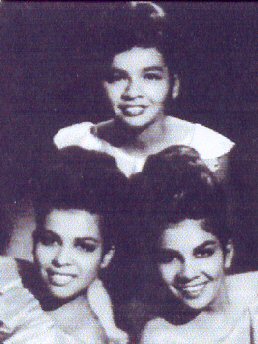
The Sisters (1964)
(clockwise
from top- Ersi, Rosella, and Mary Arvizu)
The Sisters "live"
backed by The Premiers (1964)
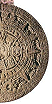
Ersi (center) with El Chicano (1971)
(on the
cover of El Chicano's "Revolution" album)
Pancho Villa and Zapata are superimposed in the foreground
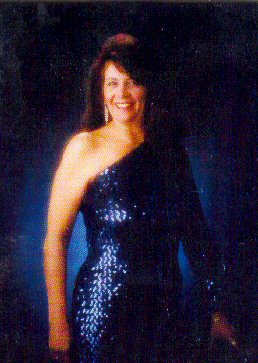
Rosella Arvizu
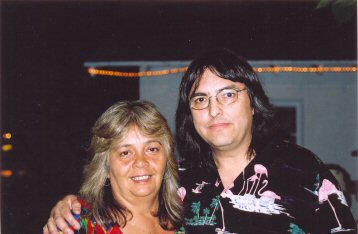
Ersi Arvizu and Mark Guerrero (2005)
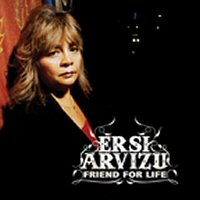
"Friend For Life"
Ersi Arvizu (2008)
(Produced by Ry Cooder)
Hear Mark's interview with
Ersi Arvizu
on his "Chicano Music Chronicles" podcast
by clicking the play button on the photo link below
Ersi Arvizu Recordings Featured
1. Cruisin' To The Hop 2.
Gee Baby Gee 3. Ooh Pooh Pah Doo 4. Sabor a Mi
5. Muy Fifi 6. Ejercito Militar 7. Soy Luz y
Sombra 8. Window of Dreams 9. El Arbol 10.
En El Tambo 11. Mi India 12. In the Closet 13.
Mil Besos 14. Friend For Life