The Mixtures:
Stompin' At the Rainbow / Breakin' Down Racial Barriers
by Mark Guerrero
The
Mixtures were a racially mixed r&b band of the 60s from
Ventura County, California, sixty miles north of Los Angeles.
However, they are considered part of the Eastside Sound because
they were managed by Eddie Davis, who was involved with many
East Los Angeles bands, and played many of the Eastside venues,
such as Rainbow Gardens in Pomona and El Monte Legion Stadium.
The Mixtures recorded one album and seven singles and were
the house band at both Rainbow Gardens and on a popular Los
Angeles television show. To devotees of the Eastside
Sound, they are best known for two of their recordings, "Olive Oyl" and "Stompin' At the Rainbow." These
tracks and others have been featured on various "Eastside Sound"
CD and vinyl album compilations.
The seeds of the Mixtures were planted at Oxnard High School
in 1957. The Playboys, who would evolve into the Mixtures,
were started by Steve Mendoza, Del Franklin, and Jess Porras.
Steve, Del, and Jess were all in the high school band, Steve
on trumpet and Del and Jess on tenor sax. They would
get together after school and jam off campus, sometimes with
an upright bass player. Steve would also play piano
at the jams. Eventually, they were invited to play at
an assembly at their high school. For their first gig,
Steve played piano, Jess, alto sax, Del, tenor sax, Johnny
Trueblood, drums, and a bass player. One of the songs
they played that day was a jazzed-up version of "The
Bunny Hop." It went over very well with the student
body. Encouraged by the experience, they kept rehearsing.
Jess Porras came from a musical family. His uncles on
his mother's side of the family were professional musicians.
Jess' mom and uncles grew up in Garden City, Kansas.
They were part of a Mexican migration to work in the fields.
Jess' dad played guitar and sang, but never went professional.
He taught Jess some guitar and some classic Mexican songs.
Jess played violin from age nine to twelve, before switching
to sax. Jess would also sit in with his uncles' bands
on percussion and got the bug to be in a band. The Playboys' next opportunity was to play at
their high school prom. By this time, they had added
Dick Halstead on guitar and Autry Joe Johnson on baritone
sax, augmenting the alto and tenor saxes which gave them a
fat sound. The Playboys began playing local gigs and
were off and running. Meanwhile Dan Pollock had a band
at Hueneme High School, the Hysterics. The other
band members were Doug Phillips, Dave Nuñez, and later Dick
Burns. When Dan left the band to join the Playboys,
the Hysterics went on to have a hit record as the Dartells
called "Hot Pastrami." Dan, who's true leanings
were toward r&b music, really admired the Playboys and
wanted to become a member. Eventually, he was able to
do so by trading his 1956 Fender Telecaster for a Fender Precision
Bass and joining as their bass player. He'd never played
the bass before, but at the time Fender basses were a rarity
so it got him into the band. Dan also knew their guitarist,
Dick Halstead, was a Navy brat and his dad would eventually
be transferred away. When that did happen, Dan moved
into the guitar slot in the band, Leroy "Zag" Soto
took over on bass, and Eddie DeRobles came in on drums.
In 1960, the Playboys changed their name to the Mixtures.
The name came from the fact that the band was a mixture
of races, made up of two Chicanos, a Puerto Rican-American,
an African-American, a half black-half Chicano, and Dan, an
r&b loving white kid.
Leroy "Zag" Soto was born in Hawaii, where many
Puerto Ricans went at the turn of the century to work on the
plantations. Zag's grandparents were part of that migration.
Zag's grandfather gave him his nickname, which he made up
because he didn't like the name Leroy. Zag's father
joined the military and the family moved to Maryland.
While back east in the late 50s, Zag saw Little Richard with
the Upsetters, Ike & Tina Turner, and other r&b greats.
He started to play r&b music while still in high school.
The drummer in his band for at least a year was Bernard Purdie, who went on to become one of the world's great drummers.
Zag's father was transferred to Port Hueneme in the Oxnard
area. It was there that he would see the Mixtures play.
It was his kind of music they were playing. He first
joined the Mixtures as a drummer, before moving over to bass.
The Mixtures felt they needed more vocal help so Del Franklin
brought in a black singer from the projects named Phillip
Tucker. The ladies loved him because he had blue-green
eyes and was well-built. Phil brought in another singer,
who was also African-American, by the name of Willis Junior
Harvey. Phil and Harv would be featured singers with
the Mixtures for a couple of years. However, Phil and
Harv would often get into trouble with the law, and would sometimes
miss gigs because they were in jail. Ironically, Harv
is now a probation officer in Oxnard. The members of
the Mixtures at this time were Del Franklin (sax and vocals),
Leroy "Zag" Soto (bass), Dan Pollock (guitar), Jess
Porras (sax), Eddie DeRobles (drums), Johnny Wells (congas),
and Steve Mendoza (piano). Phil and Harv were their
featured vocalists.
The Mixtures were introduced to Eddie Davis by Ventura disc
jockey Dick Moreland, who would go on to become a big time
DJ at KRLA in Los Angeles. Eddie loved the band and
became their promoter and producer. Davis took the Mixtures
into the studio and began booking the band at high school
dances, ballrooms, and quincenieras. On one memorable
high school assembly gig, they backed up Lou Rawls,
who was still scufflin' around at the time. The first
record the Mixtures did was as a backup band for a female
singer, Cookie Comp. The song was "I Won't
Cry," a song written by Cookie. The "B"
side was an instrumental version of "I Won't Cry,"
the same track with a sax in place of the lead vocal.
It was released on one of Eddie Davis' record labels, First
President Records. The next Mixtures record was "Darling
(Please Bring Your Love)." However, the Mixtures'
lead singers, Phil and Harv, were the only band members on
the record. Because the Mixtures didn't have studio
experience, Eddie brought in some experienced studio musicians
for this session. Two of them were Bobby Gross (of the
Olympics) on drums and Gaynell Hodge (a doo wop veteran who
had played with the Penguins of "Earth Angel" fame)
on piano. The record was released on Eddie Davis' Rampart
Records on March 10, 1961 and, according to Dan, sold 200,000
copies. The "B" side of the record was "Friendship,"
which was a song from the '30s given a rocked up treatment.
"Darling (Please Bring Your Love)" was later recorded
by the Salas Brothers on Eddie Davis' Faro label and sold
well again. (The Salas Brothers went on to form the
legendary Chicano band Tierra in the early 70s.)
The success of the Mixtures record led to better gigs, such
as the aforementioned Rainbow Gardens, El Monte Legion Stadium,
the Cinnamon Cinder in Studio City, and the popular Santa
Monica amusement park, Pacific Ocean Park. Another venue
they often played was Pop Leuder's Park in Compton, where
they were often on the bill with the Beach Boys. At
the time Compton had a large white population. The Beach
Boys also played at Rainbow Gardens with the Mixtures, but
didn't go over well there because it was a Chicano rock
& roll venue at the time. Surf music wasn't the
thing there. The Mixtures repertoire consisted of r&b
and doo wop covers with some originals mixed in. Some
of the artists they covered were James Brown, Little Richard,
King Curtis, Bobby Blue Bland, and Joey Dee & the Starlighters.
In 1961, the Mixtures became the house band on Friday nights
at Rainbow Gardens in Pomona. Rainbow Gardens had been
a venue for major big bands of the 40s such as Harry James,
Les Brown, and Count Basie. It later became a hot spot
for top Latin big bands including Beto Villa, Rene Touzet,
Tito Puente, Tin Tan, and Perez Prado. By the early
60s it became a rock & roll venue. The Mixtures
would pack 'em in at the Rainbow, which held up to 800 people.
Soon many East L.A. bands started to play at Rainbow
Gardens. My teenage East L.A. band, Mark & the Escorts
played there several times in 1964 on their Sunday afternoon
(tardeada) shows, which would run from around 4 pm to 10 pm.
We were on the bill with bands such as the Romancers, the
Desires, and the Jaguars with the Salas Brothers. The
Mixtures got the idea for their song and record "Rainbow
Stomp" from the experience that when there was any small
lull between songs at Rainbow Gardens, the dancers would stomp
their feet showing their impatience for the next song.
The Mixtures also were the house band on a television show
called "Parade of Hits" on KCOP- Los Angeles.
On the show they would back up the hit artists of the day,
including Roy Orbison, Bobby Rydell, Frankie Avalon, Gene
McDaniels, Bobby Day, Paul Anka, Freddy Cannon, the Letterman,
April and Nino Tempo, and Ketty Lester of "Love Letters"
fame. With all this success, the Mixtures still
couldn't get into certain venues because of their racial
mixture. Bigotry was alive and well in Los Angeles in
the early 60s. Sometimes after the taping of the
television show, they
would go to see Pat & Lolly Vegas play down on the Sunset
Strip in Hollywood. Still in their television make up,
they would dig the music Pat & Lolly were putting out
and marvel at Lolly's guitar playing. Pat & Lolly
had to change their names from Vasquez to Vegas to open doors
for their own careers in Hollywood.
On February 12, 1962 the Mixtures recorded a "live"
album called "Stompin' At the Rainbow." It
included covers such as "Peter Gunn," "Peppermint
Twist," "So Fine," "Besame Mucho,"
and "St. James Infirmary," along with some originals.
Most of the album was in fact recorded "live" at
Rainbow Gardens, however, "Rainbow Stomp (Pt. 1),"
"Rainbow Stomp (Pt. 2)," and "Turkey Time,"
were studio recordings added in. (Larry Tamblyn, later
to be a member of the Standells of "Dirty Water"
fame, played guitar on "Turkey Time," with Dan Pollock
on banjo.) On the studio cuts, band friends and relatives,
along with people literally brought in off the street, yelled
and screamed into a microphone. This track was mixed
into the recordings to make them sound "live."
This technique was later used on other "Eastside Sound" records
such as "Farmer John" by the Premiers, "La
La La La La" by the Blendells, and on my band, Mark &
the Escorts' single "Get Your Baby." The "live"
tracks on the "Stompin' At the Rainbow" album were
recorded by Wally Heider, who would go on to become the pre-eminent
"live" recording engineer of the era. (Crosby,
Stills and Nash recorded their first classic album at Wally
Heider's studio in 1969.) One track on "Stompin'
At the Rainbow" features a lead vocal by Chick Carlton,
who was not a member of the Mixtures. Chick often wrote
songs for many of Eddie Davis' label artists, sometimes
playing on sessions and performing "live" with them.
Carlton also recorded for Davis' Faro label with Chick Carlton
and the Majestics. The Chick Carlton vocal on the
Mixtures' album was a medley of Little Richard's "Jenny
Jenny," "Lucille," "Good Golly Miss Molly," "The Girl Can't
Help It," and Don & Dewey's "Justine." The Mixtures
often backed other artists in their "live"
performances such as Bobby Hart (later of the hit songwriting
team of Boyce and Hart) and Chris Montez of "Let's Dance"
fame. "Stompin' At the Rainbow" by the Mixtures
was released on March 19, 1962 on Eddie Davis' Linda Records.
Perhaps the Mixtures' best known record was "Olive Oyl,"
which was released November 7, 1962. The flip side was
the Mixtures version of "Canadian Sunset."
"Olive Oyl" is an instrumental featuring the rhythmic
guitar of Dan Pollock, Del Franklin's sax solos, and Leroy
"Zag" Soto providing the impressions of Popeye and
Olive Oyl on the breaks. It's similar to the way the
word "tequila" is said in the breaks of the song
"Tequila" by the Champs. The idea for the
song came about because Zag had been doing the impressions
around the band for fun. The band thought it would be
a good idea to write a song around the impressions.
"Olive Oyl" was created in rehearsal with writing
credit going to Del Franklin and Eddie Davis. "Olive
Oyl"
was released on November 7, 1962. Other singles by the
Mixtures were "Rainbow Stomp (Part 1) b/w "Rainbow
Stomp (Part 2)," March 19, 1962, "Jawbone"
b/w "It's Gonna Work Out Fine," September 9, 1962,
"Poochum" b/w "Tiki," March 5, 1963, "The
Last Minute" b/w "Sen-Sa-Shun," July 16, 1964,
and "Chinese Checkers" b/w "Dig These Blues,"
December 8, 1965. Dan Pollock's guitar teacher and mentor
was Jimmy Nolen, who was Johnny Otis' guitar player.
Jimmy had played on Otis' "Willie and the Hand Jive"
and later was James Brown's guitarist on "Papa's Got
a Brand New Bag." What better r&b credentials
can one have? Nolen passed away in 1983. Dan Pollack
believes he was forced out of the Mixtures in August of 1962
because his father, who was a city official and county sheriff
in Ventura was investigating why the Mixtures were making
only $40 a piece a week when they were packing Rainbow Gardens.
The reason he was given was that he was fired because the
owner of the Rainbow saw him kissing a black girl in the parking
lot of the establishment. She was a singer in one of
the other acts on the bill that night. Whether or not
it was the real reason, once again racism reared its ugly
head. Dan went back home and formed his own band with
Phil Tucker and a soul singer named Linda Brown.
Dan Pollock soon joined the army where he would play guitar
with special services. He was also in a band that played
off-base in Huntsville, Alabama. One of the band members
in this band was Fred Wesley, who had played with Ike &
Tina Turner. He was a trombonist and music director.
Later Wesley would fulfill the same duties for no less than
the "Godfather of Soul," James Brown. Fred
Wesley also worked with Hank Ballard & the Midnighters,
Bootsy Collins, and George Clinton. I don't think one
can have a better r&b and funk resume. After Dan
Pollock got out of the army, Wesley hooked him up with an
audition for Ike & Tina Turner's band. Dan was hired
and went out on the road with Ike & Tina. Eventually,
Dan and the band quit the revue in Phoenix, Arizona because
they didn't like the way Ike was treating Tina. They
went to Los Angeles and became the house band at the California
Club on Santa Barbara and Western. There they backed
such greats as Little Richard, Etta James, Johnny Guitar Watson,
and T Bone Walker. Dan Pollock eventually got a day
job as a dispatcher for the Ventura County Sheriff's Department
as he put it "to support his music habit."
He would play weekends. He also had a local NPR radio
show called "Blues Shack." In 1998, Dan got
fed up with club owners and the music business in general
and quit the radio show and stopped playing music professionally.
He figures he played from 1957 to 1998, forty one years ain't
bad! Pollock believes that the Mixtures didn't go farther
in the business for two reasons. First, he thinks the
Mixtures didn't come off on record as excitingly as they did
"live." He feels what they created on stage
was never duplicated on record. The second reason was
the racial prejudice they were faced with, being denied many
opportunities because of the band's racial make up.
Another source of frustration to the Mixtures, according to
Dan Pollock and Zag Soto, was that Eddie Davis was always
trying to turn them into a surf band. Surf music was
a huge craze at the time, with Dick Dale & the Deltones,
the Ventures, the Shan-tays, the Surfaris, et. al. The
Mixtures were an r&b band and were not comfortable doing
anything else.
When Dan Pollock left the Mixtures, his guitar spot was first
taken by Mike Hufford, who did one or two recordings with
them. Hufford was then replaced by East L.A.
legend Andy Tesso. Andy had played with the pioneering
East L.A. band, the Romancers. In addition to Andy Tesso,
this latter phase of the Mixtures was made up of Randy Thomas
on piano, Wayne Edwards on drums, and from the earlier Mixtures,
Del Franklin, Leroy "Zag" Soto, and Johnny Wells.
Randy Thomas and Wayne Edwards were to gain "Eastside Sound"
immortality by writing the instrumental,
"Get Your Baby," which was recorded by the Blendells,
the Premiers, and my Eastside band, Mark & the Escorts.
This Mixtures lineup played on Mixtures recordings such as
"Poochum," "Chinese Checkers," and "Sen-Sa-Shun,"
featuring Andy Tesso on lead guitar. "Poochum"
was used in the 2005 television movie "Walkout,"
about the Chicano student walkouts in East Los Angeles in
1968. This version of the Mixtures, like the earlier
version of the band, also played at Pacific Ocean Park.
From P.O.P., as it was called for short, by this time a television
show was broadcast called "Where the Action Is."
The Mixtures would perform on this show, which had the major
recording artists of the mid-60s as guests. They
also played "live" gigs with Barry White, the Rivingtons
(of "Pah Pah Ooh Maw Maw" fame), and others.
There was also more discrimination faced. They had an
opportunity to play in Las Vegas with Herb Alpert, but the
promoters in Vegas didn't want the racially mixed band.
(According to Dan Pollock, Herb Alpert used to jam with the
Mixtures at Rainbow Gardens and had previously asked Dan,
Zag, and Jess to go with him to form the Tijuana Brass, but
they declined the offer.) There was also a club in Santa
Monica called the Dovell Club. The Mixtures played there
for Latin nights, but were not allowed to play on other nights.
The Mixtures broke up in the mid-60s, leaving behind a musical
legacy and a great story.
Jess Porras was drafted around 1964. After his military
service, he went to Santa Barbara City College, where he had
Chicano Studies classes during the beginning of the Chicano
movement. He transferred to San Diego State, where he
earned bachelors and masters degrees in speech pathology and
audiology. He's now a professor at San Diego State,
teaching teachers in the fields of special education and learning
disabilities. Leroy "Zag" Soto was a helicopter
pilot in the Viet Nam war. After his service, he went
to medical school and trained as a pediatrician. He
then did emergency medicine, general practice, and is now
a physician and medical director at a federal prison in Texas.
He says he's known by many as Dr. Zag. The nickname
stuck. Dan Pollock is retired from working for the Ventura
County Sheriff's department.
Recordings by the Mixtures are available on the following
CD compilations: "The Eastside Sound - 1959-1968,"
Dionysus Records (1996) "Rainbow Stomp," "Jawbone,"
"Olive Oyl," "Tiki," "Chinese Checkers,"
and "Sen-Sa-Shun," "The West Coast Eastside
Sound, volumes one through four," Varese Sarabande Records
(1999) "Darling (Please Bring Your Love)," "Olive
Oyl," "Rainbow Stomp (Part 1)," "Karen"
by Little Ray with the Mixtures, "My Girl" by Phil
and Del with the Mixtures, "Chinese Checkers," "Don't
Play with Love" by Phil and Del with the Mixtures, and
"Poochum," and "East L.A.- Rockin' the Barrio,"
Varese Sarabande Records (2005) "Rainbow Stomp (Pt. 1)"
and "Darling (Please Bring Your Love."
This article
is based on an audio taped telephone interviews by Mark Guerrero
with Dan Pollock on October 15, 2006, Jess Porras on February
3, 2007, and Leroy "Zag" Soto on February 4, 2007.
8
photos of The Mixtures below courtesy of Dan Pollock
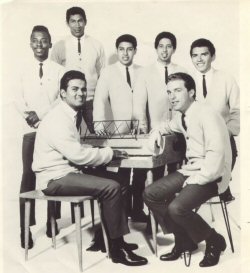
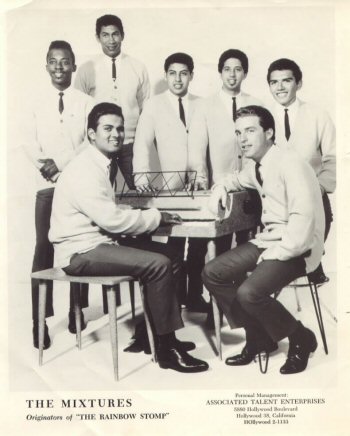
The Mixtures (1961)
(standing
left to right- Del Franklin, Johnny Wells, Jess Porras,
Leroy "Zag" Soto, and Eddie De Robles)
(seated- Steve Mendoza and Dan Pollock)
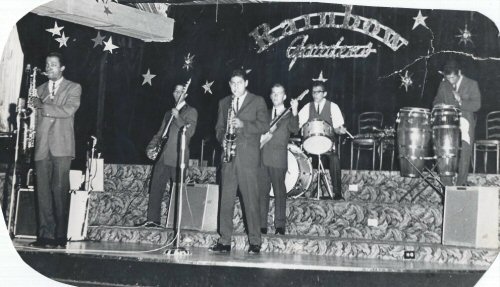
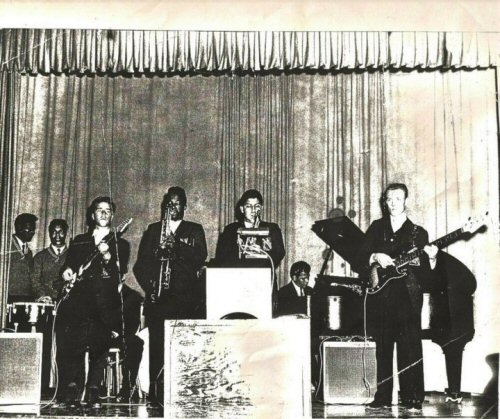
The Mixtures at Rainbow Gardens (March 1962)
(left
to right- Del Franklin, Leroy "Zag" Soto,
Jess Porras,
Dan Pollock,
Eddie De Robles, and Johnny Wells)
Steve Mendoza (far left hidden, piano)
The Mixtures (March 1962)
(standing
left to right- Steve Mendoza, Del Franklin, Leroy
"Zag" Soto,
Dan Pollock, Jess Porras, and Johnny Wells) (Eddie
De Robles on drums)
The Mixtures and The Standells at Rainbow Gardens (March 1962)
(At the
rear of the stage: The Standells, with Larry Tamblyn
on guitar
Dan Pollock {bending down in front of Larry} and Eddie
De Robles on front set of drums. Front of the stage
from left to right are Leroy "Zag" Soto
(standing),
Corkie Wilkie (back to camera with sax),
and Jess Porras)
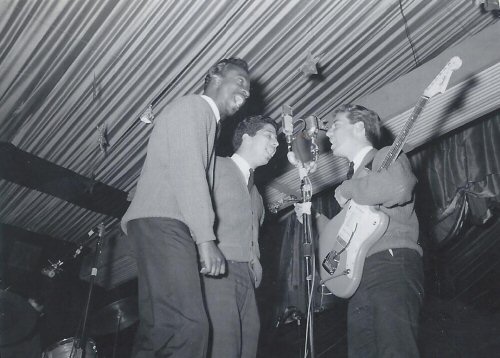
The Mixtures at
Rainbow Gardens (February 12, 1962) (taken during the live "Stompin' At the Rainbow"
album)
left
to right- Del Franklin, Leroy "Zag" Soto, and Dan
Pollock
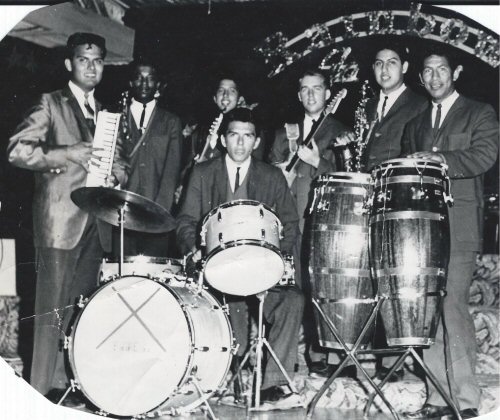
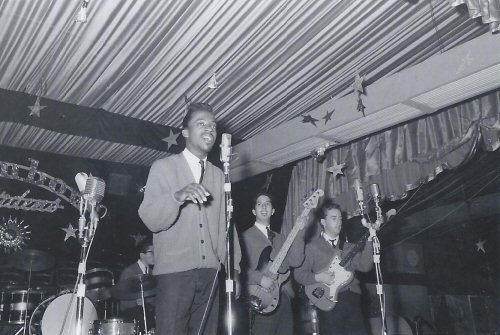
The Mixtures at
Rainbow Gardens (February 12, 1962) (taken
during the live "Stompin' At the Rainbow" album)
left to right- Eddie
Robles (drums), Del Franklin, Leroy "Zag" Soto, and
Dan Pollack
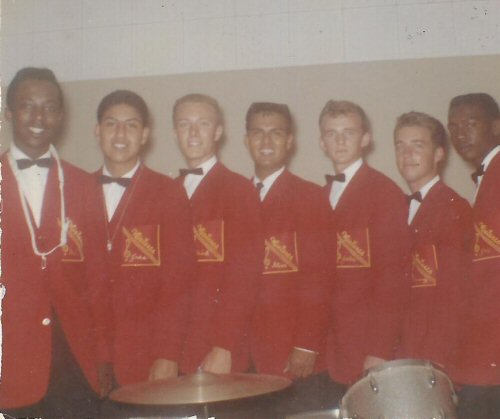
The Mixtures (1960)
(left
to right- Phil & Harv, Dan Pollock, Johnny Wells
(hidden), Del Franklin,
Leroy "Zag" Soto (hidden),Jess Porras, Steve Mendoza, and
Dick Halstead)
The Mixtures (1959)
left to right- Del Franklin, Jess Porras, Dick
Halstead, Steve Mendoza, Johnny Trueblood (Mixtures'
first drummer), Dan Pollock, and Autrey Joe Johnson